

 Facebook
 Вход
Вход
 320
320


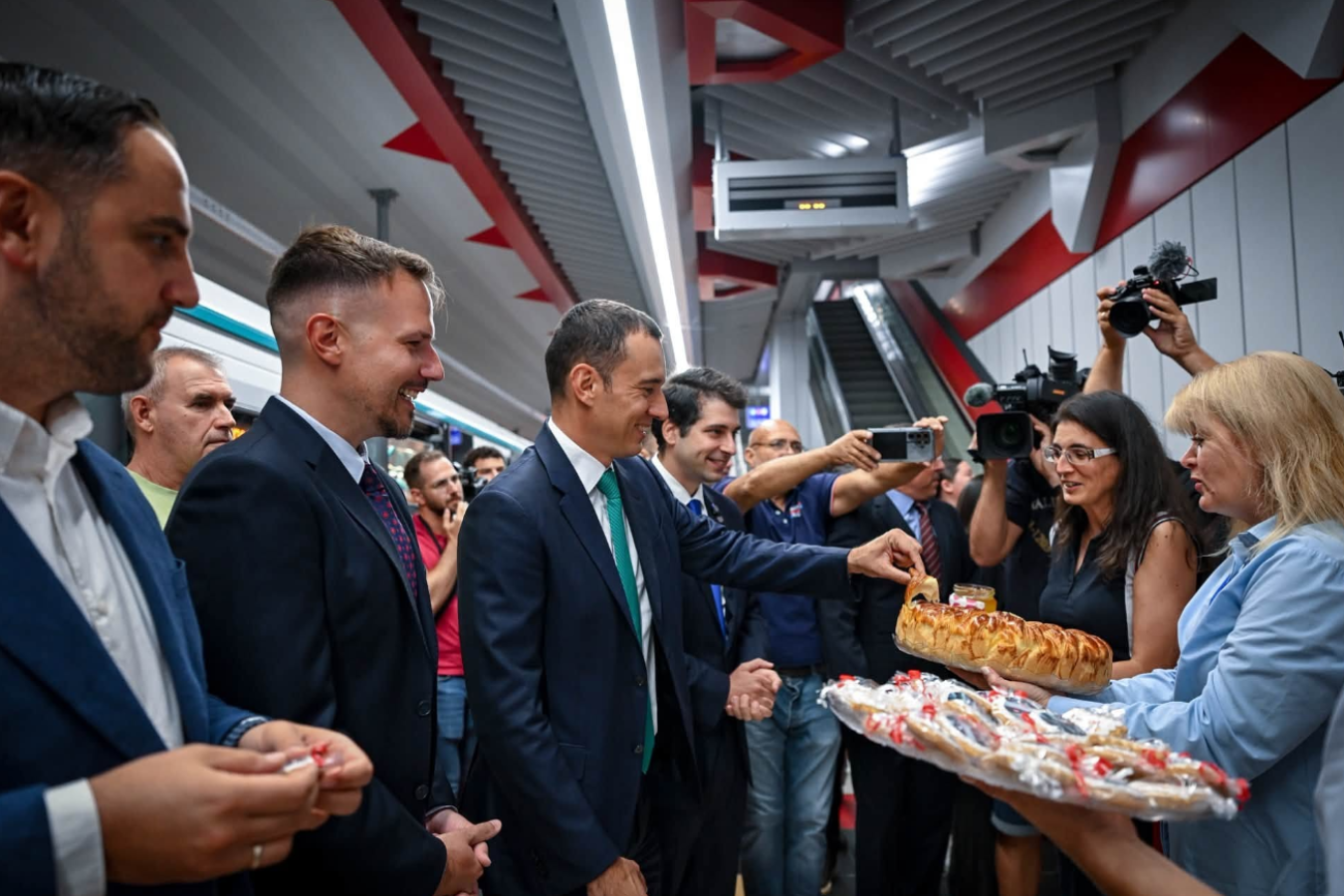
Three new metro stations on Sofia Metro’s Line 3 have opened along Vladimir Vazov Boulevard. The new section is nearly three kilometres long and includes the Georgi Asparuhov Stadium, Besarabia and Gen. Vladimir Vazov stations. The extension provides direct access to the metro for more than 45,000 Sofia residents, reducing travel time from the Levski, Suhata Reka and Hadzhi Dimitar neighbourhoods to the city centre to around 12 minutes.
The official opening of the new section was attended by Deputy Prime Minister Atanas Pekanov, Mayor Vasil Terziev, Deputy Mayor for Transport and Urban Mobility Viktor Chaushev, Nikolay Naydenov, Executive Director of Metropolitan EAD, and Stoyan Bratoev, member of the company’s Board of Directors.
The investment in the section from Hadzhi Dimitar metro station to the Levski residential district amounts to BGN 282.3 million excluding VAT (EUR 144.3 million) and was implemented with financial support from the National Recovery and Resilience Plan. Construction began in March 2022.
At the opening, Sofia Mayor Vasil Terziev emphasised the importance of continuity in implementing one of the capital’s largest infrastructure projects.
“Few people realise just how complex it is to deliver a project of this scale – years of work, technological and organisational challenges and, of course, securing substantial funding. This is a team effort,” Terziev said.
He thanked the Metropolitan team, designers and construction workers, Sofia Municipality employees, the previous municipal administration and the governments that contributed to the implementation of the project.
“This section was launched in March 2022. Since then, mayors, executive directors and teams have changed, but one goal has remained – for the metro to remain a priority and continue developing as the backbone of Sofia’s public transport system,” the Mayor emphasised.
The three new stations feature contemporary architectural designs, with their appearance reflecting the areas they serve. The Georgi Asparuhov Stadium station, for example, uses the colours associated with the stadium of the same name and incorporates symbols related to Bulgarian football legend Georgi Asparuhov.
Four new metro trains are also entering service alongside the new section. According to Deputy Mayor for Transport and Urban Mobility Viktor Chaushev, this will make it possible to reduce intervals between trains and improve passenger services. Line 3 uses a modern train control system that provides a high degree of automation.
The opening of the new stations is also accompanied by changes to feeder surface transport. New routes are being introduced in the Kremikovtsi district to provide better connections between neighbourhoods and the metro. Sofia Municipality is also working to improve transport links from other parts of the city so that the new infrastructure is accessible to more passengers.
Expansion of the metro network is continuing simultaneously in several directions. Six new stations are currently under development along the route towards Slatina and Tsarigradsko Shose Boulevard, as well as an intermodal transport hub in the Obelya residential district.
Plans also include an extension along Tsaritsa Yoana Boulevard to the Sofia Ring Road. Design work for the future extension towards Studentski Grad is nearing completion, while a metro connection towards the Simeonovo cable car is also being planned.
Sofia Municipality aims to expand the city’s metro network to 61 kilometres and 57 stations by the end of 2027.
Metro development is part of a broader policy to modernise public transport in the capital. Under the Regional Development Programme, EUR 265 million in European funding has been secured for investment in the metro and the purchase of 145 new vehicles for surface public transport – 20 trams, 75 trolleybuses and 50 electric buses.
Vasil Terziev said that, following months of work, Sofia Municipality had succeeded in securing more than EUR 260 million in grant funding with the support of the government and the European Commission, part of which is earmarked for Metropolitan. According to him, securing sustainable financial resources is essential to maintaining the pace of transport infrastructure development.
“It is important to me that we look at least 10 years ahead rather than thinking about who will cut the ribbon next. The metro is the backbone of public transport and must develop together with buses, trams, trolleybuses and feeder transport,” the Mayor said.
According to him, the goal is for the different modes of public transport to operate as an integrated system offering a sufficiently fast, convenient and predictable alternative to private cars.
“When these elements work together, people have a genuine choice – to leave their cars behind and reach their destination faster and more conveniently,” Terziev added.
With the opening of the three new stations, the continued development of the metro remains one of Sofia Municipality’s key long-term infrastructure priorities, aimed at improving urban mobility, reducing road traffic and promoting more environmentally friendly public transport.

png.png "За еврото")
png.png "КАМПАНИИ ПРОЕКТ УСПЕХ")


